The last time we Franciscan missioners met to have a reflection together (sometimes we check in, sometimes we just eat together, and other times we pray and reflect as a group), I wanted to talk about the Catholic Church's "Labor Day Statement" that was published by the United States Conference of Catholic Bishops. How does the Church's stand on the rights of the worker help us to understand our role as missioners in a poor country? The title of the statement, "Human Costs and Moral Challenges of a Broken Economy," while written in the context of the problems of the United States, elicited a strong response from us as missioners in Bolivia
While in formation in Washington, D.C., all of us had studied the Rerum Novarum enclyclical by Pope Leo XIII that served as the foundation for over a century of Catholic social teaching and its view on the dignity of workers. In this country where we live now, college graduates drive taxis or find other ways to support themselves, while beggars line the streets of Cochabamba. Of course, the U.S. bishops' Labor Day Statement called to our attention all the problems facing workers in our own country, drawing attention to the failing U.S. economy.
I have thought a lot recently about unemployment and underemployment in my own country, simply because it is all over the newspapers. I graduated years ago and experienced a recession that could be construed as just as bad as the one that has hit college graduates in the past few years. My son's graduating class, 2010, was hit hard by the recession as the new graduates sought meaningful work. I watched anxiously as they looked for work, some taking internships, one going to the Peace Corps, another working for a year before returning to school this year, while others persisted until they found acceptable or even suitable jobs. I know that the Middlebury graduates were full of optimism, energy, and idealism, desiring to take the values of their college into the workplace. I admired their patience and their trust that they would lead lives of meaning, that they would be able to make their own contribution to the world.
Similarly, I watch my daughter working in her Ph.D. program and teaching undergraduate classes. Both she and her husband are following their separate career paths, trusting that their professional lives will continue to evolve as they advance in their fields.
This trust that one's life will have purpose, the faith that opportunities will eventually allow one to forge ahead in reaching career or professional goals, as one adapts to the circumstances one finds onself in, is not a mode of thinking for North Americans alone. As one who worked as a campus minister one year at Furman University, besides teaching college for 28 years, and then coming to Bolivia to teach at the Catholic University in the yungas and currently working with the college students at San Simon University, I find that students here are just as aware as students in the U.S. that jobs will be scarce when they graduate, that it will take time, networking, and strategy to find one's place. These students lead interesting, purposeful lives while going to school, and their optimism and good works will continue as they make their way in an economy with fewer opportunities than those for U.S. graduates.
College students in Bolivia seem to remain in school longer than the four years in the U.S., with the medical and law students remaining much longer, as expected, although here they begin their professional training in their freshman year. The students whom I have met from San Simon are majoring in law, medicine, communication arts, business or engineering, to name a few majors (or carreras) and I read in the Bolivian Weekly that more trendy, marketable, and relevant (to the needs of Bolivia) majors are being developed. I have been told that younger siblings choose their major according to the books that their older siblings have bought--books are so costly here. The students at Carmen Pampa (the Catholic University in the yungas) come to school to get an education in nursing, agonomy, eco tourism, education, or veterinary medicine. The students could carry their education and training back to their communities and work there. They could be leaders. Some students from Carmen Pampa eventually come to the larger universities, in La Paz, or here in Cochabamba, at San Simon. The students have hopes that they will get work, and here in Cochabamba, students seem to be selecting majors based on what work is available when they get out. At the Cristo Rey technological school in the city, the administrators believe that the tech students who spend about three years learning a trade, whether in auto mechanics, engineering, or styling and cutting hair, stand a better chance of making a better wage than the college grads. It should be noted, also, that as all students have to write a thesis to complete their licenciatura (undergraduate degree), which in theory takes four years, many don't finish their thesis to complete their schooling.
Most of the jobs here are in agriculture, services, and industry, in descending order. Here, the unployment rate stands at 8.3% , according to the Index Mundi website, but a campesina selling lemons and manzanilla (good for tea or skill ailments) is counted as employed. According to the U.S. Department of State website, Bolivia is an entrepreurial country, where most college grads intend to start their own businesses. The average salary is under $300 a month per person (that equals our stipend and living expenses). The two pervasive problems in Bolivia, according to the Bolivian Weekly, is the percentage of income necessary to buy food, and the deficiencies in access to safe water and sanitary services. (http://www.boliviaweekly.com/report-bolivia-poorest-of-latam-countries/2259/). Next to Haiti, Bolivia is the poorest country in Latin America, with 2/3 of the population, mostly farmers, living in poverty (http://www.state.gov/r/pa/ei/bgn/35751.htm). The life expectancy for the average Bolivian is 67.5 years of age, and the median age is 22.5 years old, which accounts for why I often feel that I am the oldest person in the room or on the bus. (http://en.worldstat.info/South_America/Bolivia).
According to the UNICEF report this year,¨ in Bolivia there are 2 million children who live in extreme poverty, 800,000 who work in the street, 6,000 who live in the street, 2,000 who live in pentitentiaries with their parents, and more than 32,000 who live in homes for abandoned children¨ (http://www.boliviaweekly.com/category/education-youth/page/2 ).
The entrepreneurial system accounts for why doctors seem so accessible in Bolivia. Doctors here have to scramble for business; the simple fact of having an M.D. is not a guarantee of an excellent income. One must develop one's reputation and business. Our anfitrion (host), Henry, a pediatrician, works in a clinic in the mornings and teaches in the university in the evenings. He is not a wealthy man; his wife works as an accountant, they lived frugally, and they take in Maryknoll students as boarders. But he has an excellent reputation in the city, and is a tireless worker.
Further, last week when I stopped in at the medical center on Guayacan, not far from my house, I asked the attendant which medicine I should take for an infected bite on my arm (my arm was swollen from the elbow down). I told the attendant that I was afraid that I had been bitten by a benchuga (a beetle whose bite can lead to Chargas, which eventually enlarges the heart after a period of ten years, unless the disease is intercepted in its early stages). He looked at my arm, declared that I had been bitten by a spider, and proceeded to get me some antibiotics for my injury. When he was counting out the pills, he looked up and informed me that he was not a pharmacist, but a doctor. I had begun to think that I was dealing with a professional, so I was not surprisedto hear that a doctor had waited on me. He did not even charge me for my consultation. But the relief that I felt when I left the medical center was immense: I was terribly afraid of the benchuga beetle, and not so afraid of spider bites.
Dr. Wendy at Carmen Pampa was a mere thirty-year-old whose job was to care for the college students, faculty, and the townspeople. She was astute, energetic, and idealistic about her work. She delivered babies, coaxed mothers into vaccinating their infants, and managed all of the campus healthcare needs. She knew English because her older brother had insisted on her taking English classes. Considered tall (my height), she was athletic, traveling up and down the mountain with ease, and always available. All these examples point out that doctors don't take their clientele for granted and don't always have a receptionist or a nurse who runs interference for them.
I learned before coming to Bolivia that many professionals are out of work, that lawyers and doctors and university professors drive taxis. In a country of subsidized gasoline, taxi drivers make a good wage, but who would want to drive a taxi if they could be working in their field? Taxi drivers are usually among the friendliest and kindest people in Cochabamba, answering our questions and getting us where we need to go, with benevolence and solicitude.
The job market in Bolivia is an intensified version of what is occuring in the United States: few prospects for new college grads, record underunemployment. More so than in the United States, there is a large gap between the rich and the poor. And in Bolivia, begging is a business. I would prefer to buy the over-priced peanuts from the woman who holds out her wares to buses and automobiles caught in the afternoon traffic jam than to drop a Boliviano (worth fifteen cents) in the outstretched hand of a beggar. Once while walking down the Prado, I was accosted by a young girl, very bright looking and full of energy, who kept jumping in front of me, demanding that I give her money. I saw that her mother was with her, working the same side of the street. I wanted to shake the girl and tell her to go to school; I wanted to upbraid the mother for teaching her daughter her own trade, begging.
One of the labor issues that is bothering people the most here these days is the problem of Bolivians' migrating to other countries in order to support their families. A Maryknoll sister who has been here for over fifty years informed me that parents with young children will work in Spain, Argentina, Brazil, and the United States (I have also heard that Italy is country that employs Bolivians who can't find work in their own country). In these instances, both parents (or the one parent, if the family is a single-parent household) will work in another country and send a lot of money back home to the grandparents or aunts who are caring for the children. I was told that the parents intend to work for only a couple or years in order to straighten out their finances, but wind up working many more years than planned.In these instances, we see children raised by grandparents who cannot control them or cannot connect with them. Some children are left in the incapable hands of their older brother or sister, who may be as young as fourteen. These are only some of the situations that I have heard about. But the instances of children left behind while the parents earn money abroad
But as I read the statistics about the United States--unemployment, underemployment, children living in poverty, college grads with school debt and few prospects of employment, the growing gap between the rich and the poor, economic stagnation, uncertainty for those who are retiring or who are unable to work because of illness, and the government's difficulties in finding solutions for these problems--I see that the United States, although not in as impoverished as Bolivia, had a lot to think about on Labor Day this year.
To this end,with both the United States and Bolivia in mind, I want to offer some words from the "Labor Day Statement" from the chairman of the Committee on Domestic Justice and Human Development, from the United States Conference of Catholic Bishops:
"Our faith gives us a particular way of looking at this broken economy. From the prophets of the Old Testament to the example of the early Church recorded in the New Testament, we learn that God cares for the poor and vulnerable, and he measures the faith of the community by the treatment of those on the margins of life. . . .
"This long tradition places work at the center of economic and social life. In Catholic teaching, work has an inherent dignity because work helps us not only to meet our needs and provide for our families, but also to share in God’s creation and contribute to the common good. People need work not only to pay bills, put food on the table, and stay in their homes, but also to express their human dignity and to enrich and strengthen the larger community (Gaudium et Spes, no. 34). Human labor represents "the collaboration of man and woman with God in perfecting the visible creation" (Catechism of the Catholic Church, no. 378).
"Over the last century, the Church has repeatedly warned about the moral, spiritual, and economic dangers of widespread unemployment. According to the Catechism, "Unemployment almost always wounds its victim’s dignity and threatens the equilibrium of his life. Besides the harm done to him personally, it entails many risks for his family" (no. 2436). One of the most disturbing aspects of current public discussion is how little focus there is on massive unemployment and what to do to get people back to work. In Gaudium et Spes, the Second Vatican Council declared that 'It is the duty of society to see to it that, according to prevailing circumstances, all citizens have the opportunity of finding employment' (no. 67). As Pope Benedict warns, "Being out of work or dependent on public or private assistance for a prolonged period undermines the freedom and creativity of the person and his family and social relationships, causing great psychological and spiritual suffering" (Caritas in Veritate, no. 25). A society that cannot use the work and creativity of so many of its members is failing both economically and ethically."
These were strong words for me, as I reviewed my efforts since graduating from college years ago with a "useless" English degree. I had always felt bad when I could not find meaningful work, and always wondered why it made me feel degraded when was between jobs. The church's teachings that work "expresses human dignity and enrichess and strengthens the larger community" helped me to understand that we are made to do work, that it makes us feel a part of the whole, even to the extent that we are collaborating with God to perfect God's visible creation." And the church also warns about the harm done to people who are out of work and dependent upon others, private or public: they suffer great psychological and spiritual harm.
As our Franciscan group meditated on the Labor Day Statement, we compared our findings on work in Bolivia. One missioner pointed out that a talented and well-educated teacher could not get work in a school because she belonged to the wrong political party; hence, she worked in an after-school center. This would no occur in the United States, but again, there are many well-educated workers who do not have jobs simply because there aren't enough to go around.
So on this labor day, I see the problems of a broken economy in both Bolivia and in my own country. I see the many vendors in the cancha, and wonder who is going to buy all the goods displayed for blocks and blocks for consumers. I rejoice when a young person who has just graduated from college, either here or in the U.S., finally lands a decent job.
As a missioner, I have the ability to choose where I work. My question is where will I do the most good with my education, training, and ability to speak Spanish. I feel lucky to have my job, a job where my purpose is to supply what the people want and need. So far, people here in Bolivia need English teachers. Yes, I can do that. I taught English for twenty-eight years at the college level. I am also trained as a college chaplain. Yes, there seems to be a need for chaplains here. Other opportunities emerge: writing, singing in the choir, running a film series, and I hope many more chances to work here in Bolivia.
I am grateful to those who have supported me financially here; I am also grateful to those of you who are reading my blog; I need to have friends from home to be with me on this mission. Emerson said, "Do your work that I may know you." I know enough about the Victorian work ethic, as well as the Puritan work ethic, to know that work itself can be over-emphasized. But work is indeed our way of collaborating with God.It is one means by which we express ourselves,use our talents, and feel that we are making a difference in our world. It gives us a sense of communty. Work also, in the most expedient sense, is the means by which we can support ourselves, our families, and maintain self respect in being self-sufficient. If we are paid a living wage, we may then eat healthy food, live in decent housing, have adequate healthcare, and provide for an education for our children and even provide for ourselves in retirement .
I am glad that the Catholic church has a history of addressing the ideals of the dignity of work and the inherent rights of workers. I understand better my own drive to engage in meaningful work, and will strive to advace its ideals in the real world.

Saturday, September 24, 2011

Sunday, August 14, 2011
The Flaw in a Missioner's Contract
 |
| Courtney and Kris, Emer's oldest friends, with me, at Emer's wedding. Courtney entered the convent 2 days later. |
As I glanced at my own daughter, I realized that she had not wanted to sign this mission contract of ours, the one that her father and I had signed, that we would move to Bolivia for three years, to return only for major family events: a death in the family, a wedding, or the birth of a grandchild. We were able to take one vacation midway through our service, which was why we were walking with her in Nashville, Tennessee, at this moment Still, she had given us her blessing when we left, a blessing that is easier to give in the abstract than to maintain on a daily basis.
It had been six months ago that I had returned, in December 2010 to be with one of my dearest friends, Perle Dumas, whose physical condition was so dire that it was said that she would not live beyond that Christmas. At the age of eighty-four, she was recovering from a stroke that had paralyzed her right side. Still, when I saw her in the rehabilitation home in Crestview, Florida, she was sitting up in her wheelhair, waiting for me. She had determined that she would be sitting up, not lying down in bed, when I arrived. We talked as usual, although she tired easily. During my visit, she was able to come to her son's home and in addition eat at two of her favorite seafood restaurants in town. Except for the fact that she was tired, both mentally and physically, our visit went well. A couple of weeks later, I returned to see her with Emer and Alin. She gave Emer her Christmas present, and met Emer's new husband for the first time. She had not been able to attend the wedding because her stroke occurred just a month before.
I was unable to talk with her on the phone when I returned to Bolivia, though, because she was nearly deaf, and communication was possible only when I was in her physical presence. I felt that I was locked away from her, unable to communicate orally. All I could do was send her letters, and those were rare.
After my return to Bolivia, I heard that life had improved for Perle: her medication had been changed, and due to this change, thanks to the vigilance of her son, she was able to think clearly again. She had a serious love interest, and he was included in those nights away from the rehabilitation center when she dined out with her son and daughter-in-law. I was beginning to think that Perle would be there when I returned from Bolivia. She had even told me that she would be waiting for me.
 |
| Norbert, Perle, me, and Joel, waiting for Emer after Baccalaureate services |
Both of us were wrong. She died on July 20th, and I have been trying to absorb this fact ever since. My daughter, her husband, and her friend Mike, who had met Perle at Emer and his graduation from Harvard, attended the memorial service.
Perle has been one of my major financial supporters while I am on mission. Like Joel and me, she felt strongly that we had been called to go to Bolivia. She has accompanied me nearly all of my life as a mentor and friend. Missioner contracts by definition entail separation from one's friends and family. This is the flaw, despite email, MagicJack, and Skype, and the fact that new friends fill our lives in our new country. Still, one of the last things that Perle told me--Perle, who had come with our family to England and to Cambridge, Massachusettes, for Emer's graduation--was that she just didn't think that she would be able to make it to Bolivia. But on these sunny mornings when I walk to work, looking at the snow-covered peak of Tunari in the dawning day, I can believe that she has made it to Bolivia.
 |
| Tunari in the distance |
Monday, July 25, 2011
Parable
Three Sundays ago, three days after Joel and I returned from a month-long visit to the United States, we went to Sunday Mass at our chapel, Exaltación, and heard the parable of the Sower (la parábola del sembrador), amply expounded upon in the homily by Padre Juan Francisco, a La Sallette priest hailing from Boston, Massachusetts (he has been in Bolivia for decades).
For two Sundays in a row, July 10 and 17, the Sunday lectionary abounded with parables based on the sowing of seeds: first, the parable of the sower and the different destinies of the seeds that landed on different types of soil, and the next week, the parable of the sower who sowed good seed but his enemy came in the night and sowed bad seed among the good, as well as the parable of the mustard seed. Here is the reading:
Fifteenth Sunday in Ordinary Time
Matt 13:1-9
On that day, Jesus went out of the house and sat down by the sea.
Such large crowds gathered around him
that he got into a boat and sat down,
and the whole crowd stood along the shore.
And he spoke to them at length in parables, saying:
“A sower went out to sow.
And as he sowed, some seed fell on the path,
and birds came and ate it up.
Some fell on rocky ground, where it had little soil.
It sprang up at once because the soil was not deep,
and when the sun rose it was scorched,
and it withered for lack of roots.
Some seed fell among thorns, and the thorns grew up and choked it.
But some seed fell on rich soil, and produced fruit,
a hundred or sixty or thirtyfold.
Whoever has ears ought to hear.”
Matt 13: 18-23
“Hear then the parable of the sower.
The seed sown on the path is the one
who hears the word of the kingdom without understanding it,
and the evil one comes and steals away
what was sown in his heart.
The seed sown on rocky ground
is the one who hears the word and receives it at once with joy.
But he has no root and lasts only for a time.
When some tribulation or persecution comes because of the word,
he immediately falls away.
The seed sown among thorns is the one who hears the word,
but then worldly anxiety and the lure of riches choke the word
and it bears no fruit.
But the seed sown on rich soil
is the one who hears the word and understands it,
who indeed bears fruit and yields a hundred or sixty or thirtyfold.”
I watched and listened as Juan Francisco walked around the church, asking the people in the pews to share the ways that they heard the word of God. The children said that they heard it from their parents and teachers. The adults said that they heard God’s Word through the Bible and at Mass, as well as witnessing it through their families, the priests, and one another. The emphasis in this parable, I noted, mentally, was in hearing and understanding the word. Fearful that I would be called on as Juan Francisco walked around the church, seeking his homily from his own flock, I mentally racked up some answers in the best Spanish I could muster. I was glad that he merely welcomed back Joel and me as he passed by our pew (a row of white plastic chairs). But as I reflected on the parable, I could see that God’s word in my life had for a brief time been choked by “worldly anxiety and the lure of riches.”
Before leaving Bolivia for our trip home, I was distressed about many things in my life as a missioner, and thus frantically searched the Bible for answers. I probably was playing “Bible Bingo,” in which I randomly opened my Bible, hoping that some comforting or instructive words would leap off the page and into my uneasy heart. I found some interesting but to me, obscure, passages. My life at that time was chaotic and disorganized, and it seemed that my relationship to God, and God’s word, was the same.
In the States we experienced a hectic round of visits with friends and family. There was little time to attend Mass, except on Sundays. Even in the St. Charles Catholic Church in Bloomington, IN, where Emer and her husband Alin live, which we consider our Bloomington church, I took Communion “the wrong way,” accustomed as I was to dipping the host in the chalice, the way it is done in many churches here in Bolivia. The Eucharistic minister told me that “we don’t dip anymore.” Another cultural adjustment as one returns home.
During the months of May and June, I felt lost in the world around me, and unintegrated when alone. My world was upside down (boca abajo) in the month of May, and in June, I experienced the confusion that naturally comes with being back home in the States.
Somehow, though, when Joel and I were in the States, we were able to do many positive things:
- We gave a talk about our mission work at a small prayer group in Antioch, Tennessee (St. Ignatius Catholic Church)
- We gave a short presentation to the postulants at the St. Cecelia congregation mother house in Nashville, Tennessee. This group was the newest class of Dominican sisters, of whom our daughter’s very good friend Courtney Barnes was a member.
- My family celebrated my father’s eighty-eighth birthday, combined with Father’s Day. Almost everyone was in attendance, except for my younger sister, whose daughter just happened to give birth to yet another great-grandchild, in Henderson, Tennessee, at the time when my father was being celebrated.
- Joel and I celebrated our thirty-fifth wedding anniversary.
- Joel, Emer, Alin (Emer’s husband), and I had an early celebration of Joel’s sixtieth birthday.
- I had long conversations with our daughter, and so did her dad.
- I had coffee with my dissertation director, whom I had not seen since defending my dissertation, twenty-three years ago when I was pregnant with Norbert. My advisor continues to be the same steady, sharp, witty, and supportive person that he was years ago when I was struggling to write my doctoral thesis. He still looked the same, continues to work in and be eminent in his field, and remains one of the best listeners I have ever known. He had a peaceful spirit, this man who had been generous with his mind and spirit in supporting all of us who had come into the English doctoral program because we loved literature and enjoyed thinking, talking, and writing about culture and books. It was an honor for me to introduce him to my daughter, Emer, who is now embarking on her third year of graduate school in the same English program. As he spoke with her about the classes she was taking and her professors, it was evident that he continued to maintain an interest in the department from which he had retired fourteen years ago.
- I reconnected with friends and family, sharing many meals with them, or just taking time to enjoy long, undistorted telephone calls (Skype does not always provide clear phone conversation in Bolivia).
- I re-encountered our home in Mount Juliet, and endured the sadness of walking through our empty house that has not been rented since January. It was in need of upgrading, as the realtors say, and we hope that if we can’t sell it by the end of the summer, it will be ready, once more, with improvements, for rental.
So, I was ready to hear the parable of the sower when I returned to my home church in Barrio Majesterio in the South Zone, in Cochabamba, Bolivia. What is the word of God and where do we find it? My answer is this: it is, of course, to be found in Scripture. It is found in spiritual writings; in the Franciscan office; in poetry, novels, essays, in op-ed pieces in newspapers and journals; in the words and actions of the priests, sisters, friars, and missioners with whom I worship and work; in the children I tutor each morning, in the college students I work for and with at the pastoral juvenil, near the large public university, San Simon, and in the words of the inmates at El Abra, whose conversation with me after class makes me feel that I can somehow continue to carry on the work of accompaniment in El Abra that was first begun by Fr. Mike Johnson, who worked in this prison for six years, but who is now at St. Camillus in Silver Springs, Maryland. His picture is in the vestry of the Catholic church at El Abra prison, a portrait of his unmistakably North American face, his attire, a Franciscan habit, and in his arms, El Abra itself, the priest protectively holding it in his arms. His legacy at El Abra is still in force, and one day, both he and the inmates hope that he can return, if only for a visit.
Hearing the word of God is both a disposition and an action. Indeed, as Juan Francisco said, God’s word may be found everywhere. After this Mass, I determined that I would start a Scripture study class—not too different but in a small way, of course, from St. Francis’ literally rebuilding God’s church, San Damiano, brick by brick, when he heard God commission him to “rebuild my church.”
When I asked others about beginning a Scripture study class, I was told that one already existed. So Joel and I started to attend the class on Thursday nights, in the spirit of Franciscan accompaniment. One night after class, as I walked one of the Maryknoll volunteers home, I heard her talk about her future as a sister in the Carmelite order. She extolled the virtues of fulfilling her calling both in her daily work and as a sister. Her graduate work combined Hispanic culture, and translation of literature. She was very excited about the prospect of combining the life of a contemplative with her chosen career. Her vision of her future was inspiring to me: I was in awe of the young person, younger than my own daughter, who was going to dedicate her life to God. I thought of Courtney, whose novitiate class we had addressed on our vacation, and I was moved deeply by the thought of so many young people who had given their lives to God.
At the same time, I was jealous of the Maryknoll volunteer, soon to be a Carmelite sister. Her life as a contemplative sounded so compelling and sweet. Before becoming a Franciscan missioner, I had been struck by the service of Franciscan friars, priests, and sisters: they were dedicated to serving the poor, working for peace and justice, and caring for mother earth. They were constantly busy, and when I joined the Franciscan family, I feared that it would be difficult to find time for the personal reflection and reading of Scripture that I enjoyed while living in my home in Tennessee and while in Divinity School at Vanderbilt.
When I was in formation at Casa San Salvador, on Quincy Street in Washington, D.C., our schedule was indeed busy, and I was never one to make demands to have time alone if someone seemed to need conversation or company. I had told myself that availability to others mattered more than my own desire and need for personal prayer, reflection, and reading of Scripture or other literature that sustained me. My time in both Carmen Pampa and Cochabamba had brought had created more demands on my time, with an intense call to serve those closest to me.
After speaking with the Maryknoll volunteer who had chosen a contemplative lifestyle,it struck me that I too could lead a contemplative life as a missioner, and so I would. I desperately needed to spend more time with the Bible, in simply reading, writing, and reflecting. I needed more time to pray. The anxieties that choke the Word are real, and while all of my experiences both here in Bolivia and in the United States are part of my identity and growth, I did need to spend more time with the word of God.
"The seed sown among thorns is the one who hears the word,
but then worldly anxiety and the lure of riches choke the word
and it bears no fruit.
But the seed sown on rich soil
is the one who hears the word and understands it,
who indeed bears fruit and yields a hundred or sixty or thirtyfold.”
To reiterate, hearing the word of God is both a disposition and an action. I needed to perform the act of “hearing the word of God,” as well as remain open to its revelation in my life. Many people who read my blog have spiritualities that are different from my own. They have other ways in which they are present to God. They have places where they go to find the Divine. They read other kinds of literature and appeal to inspirational people in their lives.
My way is to read the Scripture and to pray. I have accepted that my lifestyle is both contemplative and active. The four charisms of the Third Order Regular spirituality are Conversion of the Heart, Poverty, Contemplation, and Minority. For me, Conversion of the heart and Contemplation are the two Franciscan charisms that have received short shrift in my life. But even when I examine the charism of Conversion, I note that this charism has three elements, only one of which engages the contemplative life. The first element consists of acknowledging God in the living word, in the words, deeds, and teachings of Jesus. The last two have to do with adoring God in one’s lifestyle, and serving God by working for justice and peace. As for the charism of Contemplation, the Rule of St. Francis says that “because we are made in God’s image, it is possible for us to seek union with God as we do God’s will. Thus, the Franciscan does not flee the world in order to ‘escape’ to God, but seeks immersion in its sacramental reality.”1
In the end, all reflection leads us to God’s incarnational world. I am not worried about my contemplative life drawing me away from the world, but I am worried that my immersion in the world might pull me away from God. Like many students who spend two hours studying for every hour in class, I may need more time in reflection than in actual mission. In Jesus’ words, hearing and understanding God’s word does not diminish one’s productivity, but increases it:
"But the seed sown on rich soil
is the one who hears the word and understands it,
who indeed bears fruit and yields a hundred or sixty or thirtyfold.
Additionally, the Hebrew Bible states, as found in the lectionary on the same Sunday,
Thus says the LORD:
Just as from the heavens
the rain and snow come down
and do not return there
till they have watered the earth,
making it fertile and fruitful,
giving seed to the one who sows
and bread to the one who eats,
so shall my word be
that goes forth from my mouth;
my word shall not return to me void,
but shall do my will,
achieving the end for which I sent it.
Is 55:1-11
As the priest told us, God’s word comes to us in many ways. In Jesus words, “let anyone with ears listen!”
1Franciscan Morning and Evening Praise, The Franciscan Federation, Third Order Regular of the Sisters and Brothers of the United States. Washington, D.C.: Franciscan Federation, 2009. 742, 843.
 |
| Our Wednesday breakfast group that meets after morning Mass: Sr. Lilly (Maryknoll, from Louisville, KY), Brother Adrian, Maryknoll volunteer Willa (California), Padre Juan Francisco (from Boston), Padre David, Sr. Maggie (Maryknoll, from Tanzania), and me |
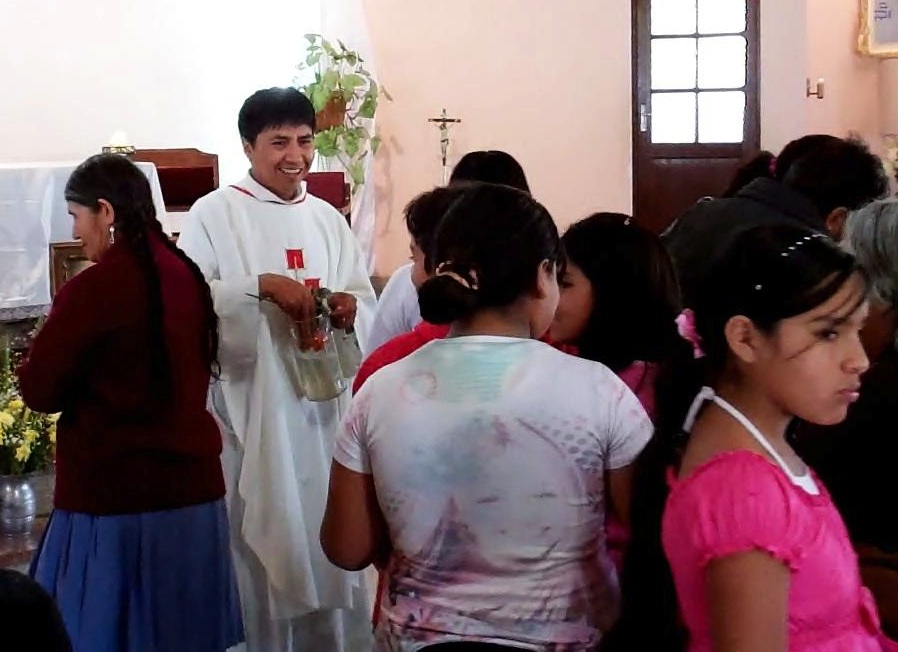 |
| Padre David blessing the people after Mass |
 |
| The San Damiano Cross |
 |
| San Damiano Church in Assisi Francis was commissioned by God to "rebuild my church" while praying in this chapel. Apparerently, God was speaking figuratively, not literally. Still, the church seems to be in good repair. |
 |
| Our unweeded garden |
Tuesday, April 26, 2011
On This Easter Weekend
On this Easter Weekend,
I am living in the South Zone of Cochabamba, Bolivia, near the Alalay Lagoon, and this Friday after attending the veneration of the Cross at the Mass of our local church, I walked up the hill in our neighborhood with other members of my church, in the procession that enacted the stations of the Cross. In this picture you can see one of the electrical towers on the hill above me as they appear from my back yard.

When I left Cochabamba last June, I felt that as a visitor to the city, I had seen all that the city had to offer. I knew by heart the main avenues and plazas, had discovered my favorite restaurants, and had visited the main attractions. As an outsider or tourist, I knew the city. But upon our return, we have become residents of the city. We live in a neighborhood in the South Zone, reputedly the poorest part of town, but somehow our neighborhood has its own beauty, well-tended parks and new covered canchas where the children can play soccer, basketball, or volleyball, or the families can gather for socializing. The existence of so many canchas demonstrates Bolivia’s acknowledgement that sun here is dangerous for all during the daytime. A new high school named October 24 (the date of President Evo Morales’ birthday) is just up the street from our small house, and just around the corner is the Cochabamba home of Evo himself.
It is a new Cochabamba for us. Our current home was the former home of the Maryknoll missioners, Evan and Susan Cuthbert, and their daughters Mary and Rose, who have returned to Boston after six years of service. We knew them as we know most of the Maryknoll missioners—they came to events at the Maryknoll Language Institute, and Evan planned the Maryknoll students’ trip to Chapari, a major coca-growing region in Bolivia (along with the Nor Jungas, where we lived before moving here) and the jungle region of Bolivia, as the Chapari River is a tributary of the Amazon.
The home and yard are models of ecological sustainability, with a thriving vegetable garden, covered by netting to offset the Bolivian sun, an ample compost pit, rain barrels, and a grassy yard with lantana, large geraniums, bougainvilleas, a lilac bush, herbs (sage, basil, anise, and rosemary), and a grapevine growing on the lattice over the patio. We also enjoy the pacai tree, which provides shade and pacai for those who enjoy this kind of fruit. On the Dia de los Niños (Children’s Day), the owners of our house came with their children and nephew to harvest the picai. We were honored to be a part of their celebration and know that the picai would be enjoyed by others. Here is one shot of our yard.

I am immersed in the social life of my neighborhood. Working with the children in the tutoring center, teaching (along with Joel) the two orders of sisters who are obligated to learn English, as well as attending early weekday Masses at the parish church and having breakfast with the sisters and priests afterwards on Wednesdays, I know that I have meaningful work to perform even if there is a blockade or transportation strike. But I still have work to do outside the neighborhood.
I work with the internados (inmates) at the prison El Abra, which means “the clearing,” on Thursday and Friday afternoons. Joel and I teach English classes for two hours each day, using the library as our media room and the church as our classroom. The library was created when Father Mike Johnson, now the pastor at St. Camillus Church in Silver Springs, Maryland, was there in 2000-2006.We have eighteen students, although on a typical day, ten will show up for class. We attended Easter Mass at the prison.
I also work in the theology library at the pastoral juvenil, the college campus ministry office in Cochabamba, very close to San Simon, a large university in Bolivia. The students at the juvenile have welcomed me into their community. To show them my gratitude for all their conversation and for sharing in their worship services (always original, reverent, and relevant), I brought them two apple pies last week. We polished these off with dispatch, and I hope to bring fudge pies the next time. (Pie crusts cook well at a higher altitude, or at least that is my theory.)
These students are not necessarily preparing to be sisters, nuns, or priests. They are studying in many different disciplines: orthodontics, medicine, communication, and engineering, for example. But they are serious about serving Christ in their careers, and have dedicated themselves to lives of service. In this sense, and in many other ways, they remind me of the EVM students (exploration of vocational ministry) when I was an intern chaplain at Furman University, who, like the students in Cochabamba, see their lives as mission, regardless of which career they choose to enter. They are the Church.
Likewise, all the missioners, priests, brothers, and sisters who surround Joel and me in our life here in Cochabamba, in our neighborhood, in the rural areas, and in the city, have provided a sense that God’s kingdom is growing incrementally. As one of the padres here has told me, the goal of the missionaries in Latin America is to understand the needs and wants of the people here, and address those needs as well as we can, and to understand that it is only in the moment, with the person in front of us, that we see Christ. This reminds me of the perspective of Mother Teresa, whose vision was always directed to the individual in front of her, but it also reminds me of the famous prayer of the Archbishop of San Salvador, Oscar Romero, martyred in 1980:
It helps, now and then, to step back and take a long view.
The kingdom is not only beyond our efforts, it is even beyond our vision.
We accomplish in our lifetime only a tiny fraction of the magnificent enterprise that is God’s work.
Nothing we do is complete, which is another way of saying that the kingdom lies beyond us.
No statement says all that can be said. No prayer fully expresses our faith.
No confession brings perfection. No pastoral visit brings wholeness.
No program accomplishes the church’s mission. No set of goals and objectives includes everything.
That is what we are about:
We plant the seeds that one day will grow.
We water seeds already planted, knowing that they hold future promise.
We lay foundations that will lead to further development.
We provide yeast that produces effects beyond our capabilities.
We cannot do everything and there is a sense of liberation in realizing that.
This enables us to do something, and to do it very well.
It may be incomplete, but it is the beginning, a step along the way, an opportunity for
God’s grace to enter and do the rest.
We may never see the end results, but that is the difference between the master builder and the worker.
We are the workers, not master builders, ministers, not messiahs.
We are prophets of a future not our own.
I am living in the South Zone of Cochabamba, Bolivia, near the Alalay Lagoon, and this Friday after attending the veneration of the Cross at the Mass of our local church, I walked up the hill in our neighborhood with other members of my church, in the procession that enacted the stations of the Cross. In this picture you can see one of the electrical towers on the hill above me as they appear from my back yard.
When I left Cochabamba last June, I felt that as a visitor to the city, I had seen all that the city had to offer. I knew by heart the main avenues and plazas, had discovered my favorite restaurants, and had visited the main attractions. As an outsider or tourist, I knew the city. But upon our return, we have become residents of the city. We live in a neighborhood in the South Zone, reputedly the poorest part of town, but somehow our neighborhood has its own beauty, well-tended parks and new covered canchas where the children can play soccer, basketball, or volleyball, or the families can gather for socializing. The existence of so many canchas demonstrates Bolivia’s acknowledgement that sun here is dangerous for all during the daytime. A new high school named October 24 (the date of President Evo Morales’ birthday) is just up the street from our small house, and just around the corner is the Cochabamba home of Evo himself.
It is a new Cochabamba for us. Our current home was the former home of the Maryknoll missioners, Evan and Susan Cuthbert, and their daughters Mary and Rose, who have returned to Boston after six years of service. We knew them as we know most of the Maryknoll missioners—they came to events at the Maryknoll Language Institute, and Evan planned the Maryknoll students’ trip to Chapari, a major coca-growing region in Bolivia (along with the Nor Jungas, where we lived before moving here) and the jungle region of Bolivia, as the Chapari River is a tributary of the Amazon.
The home and yard are models of ecological sustainability, with a thriving vegetable garden, covered by netting to offset the Bolivian sun, an ample compost pit, rain barrels, and a grassy yard with lantana, large geraniums, bougainvilleas, a lilac bush, herbs (sage, basil, anise, and rosemary), and a grapevine growing on the lattice over the patio. We also enjoy the pacai tree, which provides shade and pacai for those who enjoy this kind of fruit. On the Dia de los Niños (Children’s Day), the owners of our house came with their children and nephew to harvest the picai. We were honored to be a part of their celebration and know that the picai would be enjoyed by others. Here is one shot of our yard.
 We have added rose bushes, impatiens, vincas, and daisies. Unlike Nora’s rose bushes, our roses have not been besieged by aphids, but by the strong cutter ants, who had stolen our rose petals to decorate their own homes. Somehow, with a little incentive to go elsewhere—yes, we did sprinkle some offsetting granules of, yes, ant poison around our rose bushes—the colony moved to the other side of our yard where they live in harmony with us and the rose bushes.
Truly, we had moved into a place where we could enjoy the beauty of Cochabamba, the city of eternal spring, and live in a Bolivian neighborhood with people from all economical and educational levels.
a flowering aloe plant in our yard
We are regulars at the tiendas on our street—where we buy milk, bread, eggs, butter, and cokes, a popular drink here in Bolivia. We buy meat from a woman who sells chicken and beef until noon, or we can buy pork chops or chicken from Sofia, the large vendor about three blocks away. If we walk just a few blocks, past the new high school, cancha, and park, we can select our fruits and vegetables from an array of fresh produce. This tienda is on one of the main avenues of our neighborhood (the avenue is not paved, but the dusty roads made of stones serve the buses and taxis well). On the next corner is the hardware store, which has supplied us with shovels, light bulbs (florescent ones, of course), and the hose and piping we have needed to connect the water from our underground water tank to the tank above our house. Joel has made friends with the family who runs the hardware store.
I am immersed in the social life of my neighborhood. Working with the children in the tutoring center, teaching (along with Joel) the two orders of sisters who are obligated to learn English, as well as attending early weekday Masses at the parish church and having breakfast with the sisters and priests afterwards on Wednesdays, I know that I have meaningful work to perform even if there is a blockade or transportation strike. But I still have work to do outside the neighborhood.
I work with the internados (inmates) at the prison El Abra, which means “the clearing,” on Thursday and Friday afternoons. Joel and I teach English classes for two hours each day, using the library as our media room and the church as our classroom. The library was created when Father Mike Johnson, now the pastor at St. Camillus Church in Silver Springs, Maryland, was there in 2000-2006.We have eighteen students, although on a typical day, ten will show up for class. We attended Easter Mass at the prison.
I also work in the theology library at the pastoral juvenil, the college campus ministry office in Cochabamba, very close to San Simon, a large university in Bolivia. The students at the juvenile have welcomed me into their community. To show them my gratitude for all their conversation and for sharing in their worship services (always original, reverent, and relevant), I brought them two apple pies last week. We polished these off with dispatch, and I hope to bring fudge pies the next time. (Pie crusts cook well at a higher altitude, or at least that is my theory.)
These students are not necessarily preparing to be sisters, nuns, or priests. They are studying in many different disciplines: orthodontics, medicine, communication, and engineering, for example. But they are serious about serving Christ in their careers, and have dedicated themselves to lives of service. In this sense, and in many other ways, they remind me of the EVM students (exploration of vocational ministry) when I was an intern chaplain at Furman University, who, like the students in Cochabamba, see their lives as mission, regardless of which career they choose to enter. They are the Church.
Likewise, all the missioners, priests, brothers, and sisters who surround Joel and me in our life here in Cochabamba, in our neighborhood, in the rural areas, and in the city, have provided a sense that God’s kingdom is growing incrementally. As one of the padres here has told me, the goal of the missionaries in Latin America is to understand the needs and wants of the people here, and address those needs as well as we can, and to understand that it is only in the moment, with the person in front of us, that we see Christ. This reminds me of the perspective of Mother Teresa, whose vision was always directed to the individual in front of her, but it also reminds me of the famous prayer of the Archbishop of San Salvador, Oscar Romero, martyred in 1980:
It helps, now and then, to step back and take a long view.
The kingdom is not only beyond our efforts, it is even beyond our vision.
We accomplish in our lifetime only a tiny fraction of the magnificent enterprise that is God’s work.
Nothing we do is complete, which is another way of saying that the kingdom lies beyond us.
No statement says all that can be said. No prayer fully expresses our faith.
No confession brings perfection. No pastoral visit brings wholeness.
No program accomplishes the church’s mission. No set of goals and objectives includes everything.
That is what we are about:
We plant the seeds that one day will grow.
We water seeds already planted, knowing that they hold future promise.
We lay foundations that will lead to further development.
We provide yeast that produces effects beyond our capabilities.
We cannot do everything and there is a sense of liberation in realizing that.
This enables us to do something, and to do it very well.
It may be incomplete, but it is the beginning, a step along the way, an opportunity for
God’s grace to enter and do the rest.
We may never see the end results, but that is the difference between the master builder and the worker.
We are the workers, not master builders, ministers, not messiahs.
We are prophets of a future not our own.
Friday, February 25, 2011
A Reflection on Family Reunions

Festival Weekend in Carmen Pampa: Family Reunion
This mother lives in Carmen Pampa,
And her children live in Caranavi.
To me, she is the mother who comes to the children’s library
when it is closing.
She seeks books for her children,
who live far away from her.
She wants them to dream of worlds other than their own.
On this day, her son, the eldest, who wears glasses,
can hold onto this woman who brings him books,
Whose love reaches him over the mountains
when they are apart—
The daughter, too, molds her body to her mother’s, absorbing strength and love.
This weekend will be long, and it stretches before them
like a parade of dancers-- never-ending.
The father is not here.
Perhaps he has to work in Caranavi,
As the mother has to work in Carmen Pampa.
There are no harsh words in this family,
no recriminations,
even if the parents no longer know one another.
I only know that that the children and their mother
meld into a family of three, the touch of the children
reminding her of all those days that
stretch behind her as the weekend is spread out before them,
a glorious banquet where all may love one another
as much as they want, until the moment of return
to separate lives,
where children return to their schools, and parents return to work,
when a mother thinks about which books her children would enjoy.
My husband is shooting the picture.
He is a father, and his children are far away.
I am a mother, and I am looking at the picture.
I have been in this photo,
my children so young and close to me,
my husband taking the picture.
I always bought my children books
And took them to libraries.
Now that I am far away from my child,
I look at pictures and think about the books she is reading.
I cannot send my son books now, but I know that
Because I bought him books, some of which he did not read,
He knew that I wanted him to live in other places-- not just Tennessee.
This reunion is short.
But the children will carry their books back to Caranavi,
and smile as they dream of their return.
This mother lives in Carmen Pampa,
And her children live in Caranavi.
To me, she is the mother who comes to the children’s library
when it is closing.
She seeks books for her children,
who live far away from her.
She wants them to dream of worlds other than their own.
On this day, her son, the eldest, who wears glasses,
can hold onto this woman who brings him books,
Whose love reaches him over the mountains
when they are apart—
The daughter, too, molds her body to her mother’s, absorbing strength and love.
This weekend will be long, and it stretches before them
like a parade of dancers-- never-ending.
The father is not here.
Perhaps he has to work in Caranavi,
As the mother has to work in Carmen Pampa.
There are no harsh words in this family,
no recriminations,
even if the parents no longer know one another.
I only know that that the children and their mother
meld into a family of three, the touch of the children
reminding her of all those days that
stretch behind her as the weekend is spread out before them,
a glorious banquet where all may love one another
as much as they want, until the moment of return
to separate lives,
where children return to their schools, and parents return to work,
when a mother thinks about which books her children would enjoy.
My husband is shooting the picture.
He is a father, and his children are far away.
I am a mother, and I am looking at the picture.
I have been in this photo,
my children so young and close to me,
my husband taking the picture.
I always bought my children books
And took them to libraries.
Now that I am far away from my child,
I look at pictures and think about the books she is reading.
I cannot send my son books now, but I know that
Because I bought him books, some of which he did not read,
He knew that I wanted him to live in other places-- not just Tennessee.
This reunion is short.
But the children will carry their books back to Caranavi,
and smile as they dream of their return.
Wednesday, January 5, 2011
Intercarreras and Goodby to UAC-Carmen Pampa
We are leaving Carmen Pampa, where we had anticipated that we would stay for the entire three years of mission. However, considering all the variables, our organization, FMS, and we decided that we should return to Cochabamba to serve in the urban ministry there. I want to take this time in my blog to highlight those major events that I both witnessed and took part in at this Unidad Academica Campesina, UAC, one branch campus of the Catholic University of Bolivia.
The Intercarreras, which means “between the majors” (carrera also means "race"), was the university's celebration of the school’s anniversary. Each one of the six majors here, including pre-university, competed in sports (volleyball, futbol [soccer], and basketball [women’s]), theatre, karaoke, and dance (both traditional Bolivian dance and modern). The loud cheering of the students for their own teams in the competitions reminded me of high school pep rallies, with gigantic banners and each group donning its carrera colors.
I was surprised by the intensity of the competition, as well as unprepared for the way that it would pre-empt classes. As I mentioned in the previous blog, one of my classes was cancelled because students had to select their carrera’s Mr. and Ms. Carmen Pampa candidates. Students missed classes so that they could go to skit and dance practice. I myself rushed into class one day after a strenuous forty-five minute dance practice (I danced the morenada, a dance that involved just a few variations of dance steps, designed in terms of costume and exertion for young to middle-aged women). Arriving afterwards in the classroom, I not only looked disheveled-- had been pulled away from my class preparation in order to practice the dance--my my brain was disheveled.
Everything stopped the Wednesday of the week of the anniversary celebration. All students, faculty, and staff were mandated to attend the official opening of the new women’s dorm. The area in front of the dorm, and behind our apartment, had been newly grated and graveled. The perfectly landscaped dorm shone in its pristine beauty. After many speeches, some Afro-Bolivian music, and a play that dramatized the plight of the poor, Andean student who was welcomed with open arms and a beca (scholarship) into the university, many of the participants danced in the hot sun, glad that they could celebrate the bounty represented by the new building, provided for the most part by USAID (Aid from the United States). After the celebration, all of us in the audience were able to troop into the new dorm to see for ourselves the dormitory rooms, shining bathrooms, and study rooms. All the women living on the upper campus would live in the new residence, which would open up more room for all and enable more students to come to Carmen Pampa.

The Minister of Coca, a dignitary from USAID, another dignitary, and Padre Freddy, president of UAC-Carmen Pampa, perform the ribbon-cutting ceremony.

All of us listening to the speeches during the ceremony. If you enlarge this, read the sign about campesino education and note that I am standing up against the wall.

A dramatic reenactment of two parents learning that their daughter will be able to attend college at UAC-Carmen Pampa.

Afro-Bolivian musicians and dancers.

Joel took this picture of me with his students Elizabeth and Nieves, who have recently graduated.

The new women's dorm

Padre Israel, on the right, touring the new dorm with the rest of us. Israel is a priest as well as a student in the agronomy department. He is a dedicated priest and a friendly, unassuming person.
Each night brought a new competition: drama, dance, and karaoke. The theme receiving most air play was violence in the home. Alcoholic fathers were the source of much of this violence, which reflected a significant social problem in Bolivia. The nursing students presented a satire on the cholitas in the marketplace. Although I couldn’t make out all of the language, I had been to the marketplace enough to laugh at the satire, one which I as a gringa would not dare to make.

A comedic skit about cholitas in the market.
The entire university was out in force for four days, From Thursday, September 30th (actually on the 29th, if one counts the “ribbon cutting” of the new dorm) until Sunday night, activities began at 7:00 a.m. and ran until 2:00 in the morning. There was a celebration of the transitus of St. Francis also, when all of us created a natural setting for the St. Francis statue, along with his dog (or domesticated wolf). Just before Mass, a hummingbird flew into the sanctuary and began drinking the nectar of the cut flowers that we had placed in the “woods” surrounding our saint. Joel took many pictures of the hummingbird, but in only photo is one able to see it easily.

The festival industry in Bolivia is a booming business. On the Sunday when we were to dance on the soccer field, all of us had paid for and donned our costumes. As a morenada dancer, I had a lot of trouble braiding my graying hair to complete my outfit (green polera skirt, lacy white blouse, green pointed high heels, dangling earrings, and the typical female bowler hat. A visiting friend of one of Joel’s students took me to the eco-tourism dorm to braid my hair, from scalp to tip of the hair. Using a lot of water, many little rubber bands, and finally putting the tassels at the end of my trenzas (braids), she became a very good friend in the meantime. We talked about the difference between her university experience in La Paz and her friend’s in the campo, as well as about our beliefs as Christians. She wanted to use her English, which was impeccable, and I was only too glad to listen to and talk with her.
Our dance began on the stony road in front of the church and proceeded to the soccer field. I danced with the school’s lawyer, the Columbian missionary Manuala, and Lucia, who worked in the main office, along with the school nurse/librarian Danny, the head of the organic gardening Rosemary, and my department head, Ximana. All of us were mutually supportive, dancing in very high heels on a road that I had difficulty walking on in my walking shoes. But on and on we danced, the force of peer pressure on another, and the all-for-one, one-for-all mentality. We looked pretty good, although one step continued to confuse me.

The whole school danced. Dancing was, it is true, mandatory, and all of us had to pay for our not-inexpensive uniforms, but it was with a sense of solidarity that staff, faculty, and students danced. Joel was the official photographer, and his pictures caught all of us in action, a bit winded, overheated, with blisters forming on our feet (mine remained there for a month), but grinning as we dipped, waved our hands, and swayed to and fro. I thought of the subversive nature of some of the native dances, the dances that depicted the enslavement of the African slaves brought to Bolivia, as well as the indigineous men and women forced to work for the Spanish. The rattles of the dancers stood for the clattering chains of the slaves, and the long tongues on the masks showed the slaves’ exhaustion. One costume of the male dancers was comprised of a series of decorative circles that completely hampered all movement except for the dancing of the feet. Other dances stemmed from the European heritage. My own costume was drawn from the costumes of the choleras of the Andes, the polera skirt being the same skirt worn by peasant women in Spain, and enforced on the indigenous women in the Andes. The bowler hat was a fashion foisted off on the women, and one part of my dance, which clashed crazily with the costume’s history, was my own fascination with my own jewelry (which I had failed to purchase or borrow). The women who danced this dance were wealthy women who had inherited the skirts of enslaved women, but whose lace and jewelry, along with the bowler hat, bespoke pride in wealth.
I am including other pictures of my friends, students, and colleagues, who also danced:
 One of the children who visit our library, also the son of two faculty members.
Here are Carlos and Gladys, our upstairs neighbors. Both of them work for the university and have a toddler,

Our students in eco-tourism
, 

Doctora Wendy, our campus physician,
on the left; Desiderio, professor in agronomy; and Ximena, head of eco-tourism.
on the left; Desiderio, professor in agronomy; and Ximena, head of eco-tourism.

Cheering students during the night competitions. As one might guess from the skeleton dressed in red, the color of the nursing major, these are the nursing students.

Modern dance also asserted itself in the later competitions. These young students are talented dancers!
After days of competing in sports, dance, theater, and karaoke (our major won in karaoke!), we had a lot of difficulty calming down from the festivities. It was only after the intercarreras Joel and I were caught in a blockade in La Paz and missed two weeks of classes. After three weeks of vacation, one could say, the two of us were able to resume our work in the classroom. Our students have now headed home for summer vacation, have gone to other universities for more school work, or are on the job market. The students in eco-tourism were a tight-knit , hard-working group, andwe hope to cross their paths in the future.
Wednesday, November 24, 2010
A Typical Atypical Day
A Typical Atypical Day
Today has been a typical atypical day. Joel and I went to bed the night before at 10:00, only to re-awaken about 2:30. We have a lot of things on our minds about our mission in Carmen Pampa, and of course, we spent a couple of hours talking. Joel took the initiative to cut up a pineapple, which, for once, was not over-ripe.
After awakening again at 8:00, I prepared my class and went down the hill to teach. I had my i-touch and speakers ready for student listening. I was also anticipating my students' book reports: we are reading children's books, like Lyle, Lyle, Crocodile, Mercer Mayer and Lillian Hoban books (illustrator of Bedtime for Frances). I was excited because one of my students was very interested in the witty writing of the Lyle, Lyle Crocodile book. All year, he has demonstrated a moderate interest, but when confronted with interesting twists on words, he had lit up with enthusiasm. So I walked into my classroom, anticipating another good class--Joel going up to the second floor to the language lab with his class and our fellow instructor Chris closing the door to his class room for second-year students. But where was my class? I looked at an empty room.
All semester there have been problems with class cancellation: the big celebration of the school's anniversary, called the intercarreras, the faculty retreat in the following week (which created a three-week hiatus between classes for my students in education), and numerous other events that pre-empted class: a birthday party for the head of the Eco-Tourism department, the dedication of a new building (which the student body and all faculty were obliged to attend), a lecture on bats (we had visiting scientists here at Carmen Pampa who were studying the numerous bats here), as well as compulsory campus cleanup days, and the election of Mr. and Ms. UAC (Unidad Academica Campesina--Carmen Pampa). I had recovered from the initial shock of class cancellations (once, 4 out of 7 classes cancelled), and our students, coming onto the end of the 20-week semester, were attending class in earnest, putting their academic work at the top of their list of priorities.After writing a note on the board, "All students will be counted absent today," followed by the date and my signature, I left the classroom after twenty minutes.
Walking back to the volunteer house, I saw two of our of guests sitting outside the church--our German volunteer, all of nineteen years old, had three guests for the week, a friend from high school, her mother, and the friend's Bolivian boyfriend. It struck me that I had the keys to the locked church that they were sitting outside of. So I offered to open the church to show them the Franciscan Church--the statue of Francis, the small fountain of water, which I couldn't turn on, the aguayo backdrop behind the hand-carved crucifix, and of course, the trip up to the bell tower, where a panoramic view could be enjoyed by all. No, it didn't stand up to the churches and spires of Germany, but it was in its own way erene and inspiring.
Then, I showed the small group our children's library, which is more like a childen's playhouse than a library. Now, it is very spic and span, after I washed the windows, walls, and curtains, and scrubbed down the table, chairs, and bench. Puzzles, games, crayons, and coloring books were stacked neatly on the small blue shelves against the wall. Later that day, Joel would be showing the movie Toy Story 3 on the homemade screen, while the children eat the popcorn that he made in the wee hours with our deluxe popcorn popper, along with the Tampico (a version of Tang in a bottle) he would buy for them, sitting on the large straw mats on the newly-created cement floor (thank you, José Tintaya!). The children would sit on the brightly colored mats that we had purchased two weeks ago in La Paz. I am told that sometimes there are 22 children in this space.
After serving as a tour guide for the first time, I gave our guests hugs as they departed by mini-van to Coroico, from which they would then travel to La Paz. The mother herself would be going on to Germany, while the daughter and her boyfriend would return to Cochabamba. I was glad that my day had not been wasted, that I had indeed occupied the role of a docent (from Merriam -Webster's 1 : a college or university teacher or lecturer 2 : a person who leads guided tours especially through a museum or art gallery).
Having asked Joel to take over my office hour for me (which I later found, was impossible because the office was locked), I packed up my mochila (backpack) and started up the hill. I was accompanied by Don Oscar, the head of community service on the lower campus [Manning], who told me that he actually lived in the house beside the coffee plantation (cafetal), along with his wife and three children, two of whom went to the elementary school that the Xavier brothers had founded in Carmen Pampa, the oldest of whom attending a high school in a nearby town.Bidding him good-bye at the cafetal, I continued to trudge up the hill at my own pace, walking by the state-of-the-art, cutting edge recycling center.
Suddenly at the head of the trail, I saw my class. I heard a gentle, "Oh NO . . . " emit from the female students. There was the other docente, the head of our eco-tourism department, leading my students from the upper campus (Leahy), where Joel and I live, down the path to the lower campus. It had been a field trip for the students! How nice! And the other docente had simply forgotten to inform me. Alas, there had been no transportation available or the students would have been back on the lower campus by 11:00 a.m., in time for class. After some teasing and a lot of reassurance that I wasn't angry, the tired crew proceeded down the hill.
I went on to my apartment. That morning, even before preparing my class, I had done what I typically do when I am a little depressed: I cleaned my apartment (which, by the way, is spotless as I type). I had deep-cleaned the bathroom, which resists cleanliness, mostly due to the shower that somehow leaks over the stall (the shower stall is the locale for washing all of our clothes) and the dust that collects in our apartment that is tracked into the bathroom onto the water throughout the space. As I came into the apartment, I attacked the dishes in the sink, took a shower (always has to be done after a walk up the hill), started another "load" of clothes in the shower stall, and decided to roast some raw peanuts for snacking.
I received a Skype call from Emer, which I certainly would have missed on a typical day. Her new family is visiting for Thanksgiving, her husband's parents and brother, which brought to mind the obvious: our family was apart for the first time ever on Thanksgiving. It was good that she was responsible for the Thanksgiving dinner for the new in-laws, as one experience could cancel out the other one. On Skype, I was able to visit with our cat, Elliott, who has been in our family for seven years.Carmen Pampa's Thanksgiving would be celebrated on Saturday. Joel is responsible for the sweet potatoes, and I am making the fudge pies and apple cider. A comparison of my menu with Emer's as well as the menu for my own family in Nashville (I got to talk with my dad's wife, Mary, so I am connecting with family today in the event that the internet breaks tomorrow--the family that will gather tomorrow in Nashville is my dad, his wife, Mary, my younger brother and his intended, Wendy, and my sister's family) revealed that Thanksgiving meals should somehow be comprised of a green bean casserole, mashed potatoes, devilled eggs, and fudge pies, along with the usual turkey and dressing.
At Carmen Pampa, we will be celebrating Thanksgiving with 27 people all told, priests, sisters, the core group of volunteers/missioners/gringo staff, and some visitors from the U.S. embassy in La Paz. Unlike the North Americans who will be eating in wintry dining rooms, possibly with candlelight, we will be dining in the flower-lined garden between the Convent and the volunteer house, with two tarps to keep the sun out of our eyes. I am told that our guests will bring six bottles of wine each.
Tonight there will be no Mass, since the priests and sisters are having a diocesan-wide convocation. But Wednesday night Masses are iffy these days, and I know that last week after I set up the Mass, I was told by the main office that there would not be a Mass. I took everything down and locked up the church, only to find that one of the priests had driven from Coroico at the last minute to have Mass. When he arrived, just about ten minutes after I had closed up the church on the upper campus, I sheepishly waved at him from the tienda where I was eating my fried chicken and french fries. NOT MY FAULT, I wanted to say. I really like this particular priest.
There are so many opportunities for mis-communication. The president of the college had not felt well, so he went home, after telling the office that there would be no Mass. Later, the other priest was told that Fr. Freddy was sick, and jumped into his car to have Mass. The replacement priest remarked on how clean the church was, with fresh flowers, but no people. The same thing happens on the lower campus, where I am told to have the church down there ready for Mass, since there is a fifty-fifty chance that there will be a Mass. If my Spanish were as good as Sr. Jean's, and I pray that one day it will be much better than it is now, I will do what she would do if she were not on a two-month vacation: I would have a Communion service. And maybe someday I will give what Catholics call a "reflection" (so called if a female or other non-ordained person gives a sermon/homily) in Spanish. Having preached in Protestant churches, but not in the Catholic Church, I am able to do some things in my own language that I cannot do in Spanish.
I have now arranged to communicate by email with the priests on Wednedays and Thursdays. So things get better as I learn the Bolivian ropes. Our cell phone tower was working for two days, but a thief stole the cable, costing over fifteen thousand dollars, and so we are once again back to ground zero: a cell phone in every pocket and a brand-new tower on the hill, but no cellular communication.
As I have written my blog, I have been waiting for the faculty bus to take all of us administrators down to the lower campus for the faculty meeting. This is a rare opportunity for me to go to the meeting, since the Mass is definitely not going to happen. But the bus has not appeared (I later found out that it was in the shop in Coroico).Tonight, because the Mass is definitely cancelled, Joel and I are able to attend the English club meeting: the students studying English are able to watch movies in English, play cards or games, and have an immersion night in English. I am waiting to find out if the social hour is actually going to take place.
What does work? The campus ministry meetings always happen every Tuesday night; the Wednesday night Masses were celebrated like clockwork until about three weeks ago, with beautiful flowers and joyous music; Sunday Mass always "happens;" English program meetings and community meetings convene without fail, and the students have been coming to class faithfully since Joel and I had to miss two weeks of classes due to the blockade. I noted also that one of the most beautiful garden paths that I have ever seen, in North American, Europe, and South America, had been created less than a half mile below our living quarters, and that tourists from other towns in Bolivia had come to enjoy both its beauty and the vista it offers of the Andes Mountains.
I can't help but think that as my Spanish improves, I will be more "in the know" about what happens and what doesn't happen. In the United States, I was one of those people who always came to meetings about ten minutes late. Maybe I was a kind of rebel; here my rebellion takes the form of being on time. **I look forward to seeing what kind of person emerges from this mission experience in the coming two years.
**I still have the capacity to be late . . . .
Today has been a typical atypical day. Joel and I went to bed the night before at 10:00, only to re-awaken about 2:30. We have a lot of things on our minds about our mission in Carmen Pampa, and of course, we spent a couple of hours talking. Joel took the initiative to cut up a pineapple, which, for once, was not over-ripe.
After awakening again at 8:00, I prepared my class and went down the hill to teach. I had my i-touch and speakers ready for student listening. I was also anticipating my students' book reports: we are reading children's books, like Lyle, Lyle, Crocodile, Mercer Mayer and Lillian Hoban books (illustrator of Bedtime for Frances). I was excited because one of my students was very interested in the witty writing of the Lyle, Lyle Crocodile book. All year, he has demonstrated a moderate interest, but when confronted with interesting twists on words, he had lit up with enthusiasm. So I walked into my classroom, anticipating another good class--Joel going up to the second floor to the language lab with his class and our fellow instructor Chris closing the door to his class room for second-year students. But where was my class? I looked at an empty room.
All semester there have been problems with class cancellation: the big celebration of the school's anniversary, called the intercarreras, the faculty retreat in the following week (which created a three-week hiatus between classes for my students in education), and numerous other events that pre-empted class: a birthday party for the head of the Eco-Tourism department, the dedication of a new building (which the student body and all faculty were obliged to attend), a lecture on bats (we had visiting scientists here at Carmen Pampa who were studying the numerous bats here), as well as compulsory campus cleanup days, and the election of Mr. and Ms. UAC (Unidad Academica Campesina--Carmen Pampa). I had recovered from the initial shock of class cancellations (once, 4 out of 7 classes cancelled), and our students, coming onto the end of the 20-week semester, were attending class in earnest, putting their academic work at the top of their list of priorities.After writing a note on the board, "All students will be counted absent today," followed by the date and my signature, I left the classroom after twenty minutes.
Walking back to the volunteer house, I saw two of our of guests sitting outside the church--our German volunteer, all of nineteen years old, had three guests for the week, a friend from high school, her mother, and the friend's Bolivian boyfriend. It struck me that I had the keys to the locked church that they were sitting outside of. So I offered to open the church to show them the Franciscan Church--the statue of Francis, the small fountain of water, which I couldn't turn on, the aguayo backdrop behind the hand-carved crucifix, and of course, the trip up to the bell tower, where a panoramic view could be enjoyed by all. No, it didn't stand up to the churches and spires of Germany, but it was in its own way erene and inspiring.
Then, I showed the small group our children's library, which is more like a childen's playhouse than a library. Now, it is very spic and span, after I washed the windows, walls, and curtains, and scrubbed down the table, chairs, and bench. Puzzles, games, crayons, and coloring books were stacked neatly on the small blue shelves against the wall. Later that day, Joel would be showing the movie Toy Story 3 on the homemade screen, while the children eat the popcorn that he made in the wee hours with our deluxe popcorn popper, along with the Tampico (a version of Tang in a bottle) he would buy for them, sitting on the large straw mats on the newly-created cement floor (thank you, José Tintaya!). The children would sit on the brightly colored mats that we had purchased two weeks ago in La Paz. I am told that sometimes there are 22 children in this space.
After serving as a tour guide for the first time, I gave our guests hugs as they departed by mini-van to Coroico, from which they would then travel to La Paz. The mother herself would be going on to Germany, while the daughter and her boyfriend would return to Cochabamba. I was glad that my day had not been wasted, that I had indeed occupied the role of a docent (from Merriam -Webster's 1 : a college or university teacher or lecturer 2 : a person who leads guided tours especially through a museum or art gallery).
Having asked Joel to take over my office hour for me (which I later found, was impossible because the office was locked), I packed up my mochila (backpack) and started up the hill. I was accompanied by Don Oscar, the head of community service on the lower campus [Manning], who told me that he actually lived in the house beside the coffee plantation (cafetal), along with his wife and three children, two of whom went to the elementary school that the Xavier brothers had founded in Carmen Pampa, the oldest of whom attending a high school in a nearby town.Bidding him good-bye at the cafetal, I continued to trudge up the hill at my own pace, walking by the state-of-the-art, cutting edge recycling center.
Suddenly at the head of the trail, I saw my class. I heard a gentle, "Oh NO . . . " emit from the female students. There was the other docente, the head of our eco-tourism department, leading my students from the upper campus (Leahy), where Joel and I live, down the path to the lower campus. It had been a field trip for the students! How nice! And the other docente had simply forgotten to inform me. Alas, there had been no transportation available or the students would have been back on the lower campus by 11:00 a.m., in time for class. After some teasing and a lot of reassurance that I wasn't angry, the tired crew proceeded down the hill.
I went on to my apartment. That morning, even before preparing my class, I had done what I typically do when I am a little depressed: I cleaned my apartment (which, by the way, is spotless as I type). I had deep-cleaned the bathroom, which resists cleanliness, mostly due to the shower that somehow leaks over the stall (the shower stall is the locale for washing all of our clothes) and the dust that collects in our apartment that is tracked into the bathroom onto the water throughout the space. As I came into the apartment, I attacked the dishes in the sink, took a shower (always has to be done after a walk up the hill), started another "load" of clothes in the shower stall, and decided to roast some raw peanuts for snacking.
I received a Skype call from Emer, which I certainly would have missed on a typical day. Her new family is visiting for Thanksgiving, her husband's parents and brother, which brought to mind the obvious: our family was apart for the first time ever on Thanksgiving. It was good that she was responsible for the Thanksgiving dinner for the new in-laws, as one experience could cancel out the other one. On Skype, I was able to visit with our cat, Elliott, who has been in our family for seven years.Carmen Pampa's Thanksgiving would be celebrated on Saturday. Joel is responsible for the sweet potatoes, and I am making the fudge pies and apple cider. A comparison of my menu with Emer's as well as the menu for my own family in Nashville (I got to talk with my dad's wife, Mary, so I am connecting with family today in the event that the internet breaks tomorrow--the family that will gather tomorrow in Nashville is my dad, his wife, Mary, my younger brother and his intended, Wendy, and my sister's family) revealed that Thanksgiving meals should somehow be comprised of a green bean casserole, mashed potatoes, devilled eggs, and fudge pies, along with the usual turkey and dressing.
At Carmen Pampa, we will be celebrating Thanksgiving with 27 people all told, priests, sisters, the core group of volunteers/missioners/gringo staff, and some visitors from the U.S. embassy in La Paz. Unlike the North Americans who will be eating in wintry dining rooms, possibly with candlelight, we will be dining in the flower-lined garden between the Convent and the volunteer house, with two tarps to keep the sun out of our eyes. I am told that our guests will bring six bottles of wine each.
Tonight there will be no Mass, since the priests and sisters are having a diocesan-wide convocation. But Wednesday night Masses are iffy these days, and I know that last week after I set up the Mass, I was told by the main office that there would not be a Mass. I took everything down and locked up the church, only to find that one of the priests had driven from Coroico at the last minute to have Mass. When he arrived, just about ten minutes after I had closed up the church on the upper campus, I sheepishly waved at him from the tienda where I was eating my fried chicken and french fries. NOT MY FAULT, I wanted to say. I really like this particular priest.
There are so many opportunities for mis-communication. The president of the college had not felt well, so he went home, after telling the office that there would be no Mass. Later, the other priest was told that Fr. Freddy was sick, and jumped into his car to have Mass. The replacement priest remarked on how clean the church was, with fresh flowers, but no people. The same thing happens on the lower campus, where I am told to have the church down there ready for Mass, since there is a fifty-fifty chance that there will be a Mass. If my Spanish were as good as Sr. Jean's, and I pray that one day it will be much better than it is now, I will do what she would do if she were not on a two-month vacation: I would have a Communion service. And maybe someday I will give what Catholics call a "reflection" (so called if a female or other non-ordained person gives a sermon/homily) in Spanish. Having preached in Protestant churches, but not in the Catholic Church, I am able to do some things in my own language that I cannot do in Spanish.
I have now arranged to communicate by email with the priests on Wednedays and Thursdays. So things get better as I learn the Bolivian ropes. Our cell phone tower was working for two days, but a thief stole the cable, costing over fifteen thousand dollars, and so we are once again back to ground zero: a cell phone in every pocket and a brand-new tower on the hill, but no cellular communication.
As I have written my blog, I have been waiting for the faculty bus to take all of us administrators down to the lower campus for the faculty meeting. This is a rare opportunity for me to go to the meeting, since the Mass is definitely not going to happen. But the bus has not appeared (I later found out that it was in the shop in Coroico).Tonight, because the Mass is definitely cancelled, Joel and I are able to attend the English club meeting: the students studying English are able to watch movies in English, play cards or games, and have an immersion night in English. I am waiting to find out if the social hour is actually going to take place.
What does work? The campus ministry meetings always happen every Tuesday night; the Wednesday night Masses were celebrated like clockwork until about three weeks ago, with beautiful flowers and joyous music; Sunday Mass always "happens;" English program meetings and community meetings convene without fail, and the students have been coming to class faithfully since Joel and I had to miss two weeks of classes due to the blockade. I noted also that one of the most beautiful garden paths that I have ever seen, in North American, Europe, and South America, had been created less than a half mile below our living quarters, and that tourists from other towns in Bolivia had come to enjoy both its beauty and the vista it offers of the Andes Mountains.
I can't help but think that as my Spanish improves, I will be more "in the know" about what happens and what doesn't happen. In the United States, I was one of those people who always came to meetings about ten minutes late. Maybe I was a kind of rebel; here my rebellion takes the form of being on time. **I look forward to seeing what kind of person emerges from this mission experience in the coming two years.
**I still have the capacity to be late . . . .
Subscribe to:
Posts (Atom)